
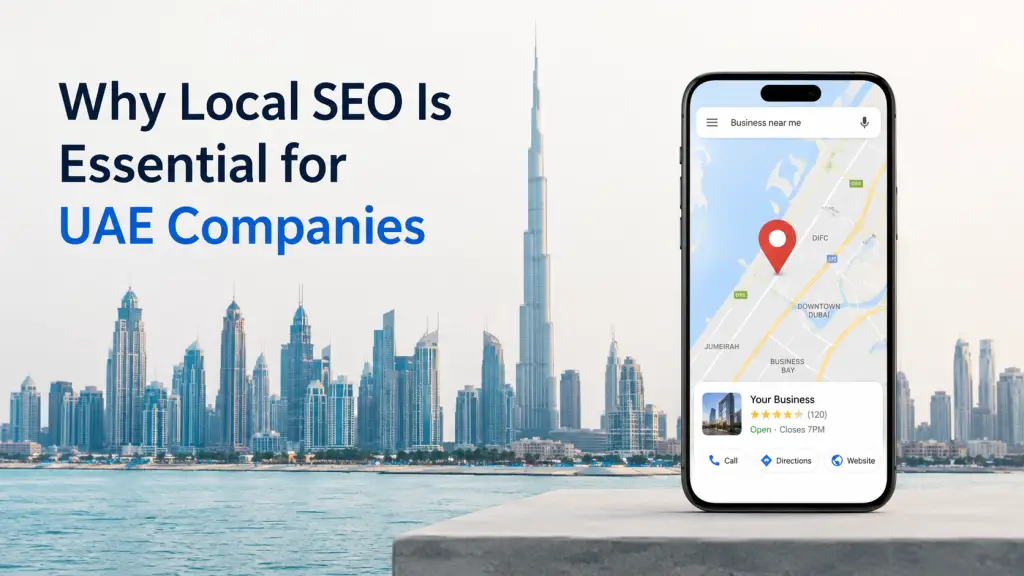
Dubai’s skyline may be full of glass towers, but the real competition for customers happens on a six-inch screen. When someone in Business Bay searches for a plumber, a dentist, or a digital agency, Google doesn’t show them the whole internet, it shows them what’s nearby, relevant, and trustworthy. That’s the world local search optimization lives in, and for UAE businesses, ignoring it means losing customers to competitors who show up first. If you’re exploring local search optimization for your business, understanding why it matters is the first step toward getting it right.
This article breaks down why location-based visibility has become non-negotiable for companies across the Emirates, and how it fits into a broader digital growth strategy.
The UAE’s Mobile-First, Map-Driven Search Culture
The UAE has one of the highest smartphone penetration rates in the world, and residents rely heavily on mobile search to make everyday decisions, where to eat, which clinic to visit, which contractor to hire. Google’s local pack (the map and three-listing block that appears at the top of search results) captures the majority of clicks for these “near me” style queries. If your business isn’t optimized to appear there, you’re invisible at the exact moment a customer is ready to choose.
This is especially true in a market as geographically compact and densely populated as Dubai, Abu Dhabi, or Sharjah, where dozens of competitors might operate within a few kilometers of each other. Winning visibility in that map pack often matters more than ranking on page one of general search results, because map results carry stronger buying intent. People searching from their phones while physically nearby are further along in their decision-making process, making these micro-moments incredibly valuable for conversion.
Building Trust Through Google Business Profile Optimization
A well-maintained Google Business Profile is often the first impression a UAE consumer has of a company. Accurate business hours, updated photos, a complete service list, and a steady stream of reviews all signal credibility before a customer ever visits your website. In a market where word-of-mouth and reputation carry significant weight, this digital storefront functions as a trust filter.
Companies that neglect their profile, leaving outdated addresses, ignoring reviews, or using inconsistent business names, often see reduced visibility and lower click-through rates, even if their actual products or services are excellent. Search engines reward completeness and consistency, treating profiles as ranking signals rather than just directory listings.
Responding to reviews, adding regular posts, and uploading fresh images also demonstrate to both customers and search algorithms that a business is active and engaged. This ongoing maintenance is a small investment that compounds over time, gradually building the kind of authority that’s difficult for newer or less attentive competitors to replicate quickly.
NAP Consistency and Citation Building Across the Region
NAP (Name, Address, Phone number) consistency is one of the most overlooked ranking factors for regional visibility. When a business’s details vary across directories, review platforms, and social profiles, search engines struggle to confirm which version is accurate, which can dilute trust signals and hurt rankings.
For UAE companies, this becomes particularly important given the number of relevant directories: government business listings, industry-specific UAE directories, chamber of commerce registries, and international platforms all need matching information. Citation building, getting your business listed accurately across these platforms, reinforces legitimacy in the eyes of search algorithms.
This is especially relevant for companies operating across multiple emirates or with several branch locations, where each location needs its own accurate, consistent listing rather than a single generic entry. Getting this foundation right often requires auditing existing listings, correcting duplicates, and establishing a consistent format that can be replicated as the business expands into new areas.
Hyperlocal Content and Community Relevance
Search engines increasingly reward content that speaks directly to a specific community rather than generic, one-size-fits-all messaging. For UAE businesses, this means creating content that references specific neighborhoods, landmarks, cultural events, or regional concerns relevant to their audience, whether that’s discussing Ramadan business hours, referencing Dubai Marina foot traffic patterns, or addressing region-specific regulatory changes.
This kind of hyperlocal content does two things simultaneously: it improves relevance signals for search algorithms and it resonates more authentically with the audience actually searching. A generic blog post about “choosing a contractor” performs differently than one titled around Dubai-specific building regulations or Abu Dhabi permit requirements.
Businesses that regularly produce this kind of geographically-anchored content tend to build stronger topical authority within their service area over time, which supports broader visibility even for queries that aren’t explicitly location-based. It also creates natural opportunities to interlink with other useful resources, such as a company’s own services overview, reinforcing site structure while giving readers a clear next step.
Competing Against International and Multinational Brands
Many UAE markets, retail, hospitality, real estate, technology, are crowded with well-funded multinational brands. A smaller or mid-sized regional company often can’t outspend these competitors on broad brand awareness campaigns. Location-based visibility levels the playing field, because it rewards relevance and proximity rather than sheer marketing budget.
A boutique agency in JLT competing against a global consultancy doesn’t need to outrank that consultancy nationally, it needs to dominate visibility within its immediate service radius, where actual customers are searching. This shift in strategy allows smaller UAE companies to carve out defensible market share by being the clear, trusted, top choice within their specific geography, even when a much larger competitor exists elsewhere.
This localized advantage also extends to voice search, which is growing steadily across the region as smart assistants become more common in homes and vehicles, and which tends to favor concise, location-specific answers over broad brand recognition.
Measuring the Impact: Foot Traffic, Calls, and Conversions
Unlike some digital marketing efforts that are difficult to tie to real-world outcomes, location-based visibility produces measurable, tangible results: phone calls, direction requests, walk-ins, and form submissions that can be traced directly back to map visibility and profile engagement.
For UAE businesses with physical locations, showrooms, clinics, restaurants, retail outlets, these metrics often matter more than raw website traffic, because they reflect genuine buying intent rather than passive browsing. Tracking these indicators over time also helps businesses understand seasonal patterns unique to the region, such as shifts in demand during tourist season or around major shopping events.
This data-driven feedback loop allows companies to refine their approach continuously, reallocating effort toward what’s actually converting rather than guessing. It also provides a clearer picture of return on investment, which is particularly valuable for businesses balancing multiple marketing channels and needing to justify continued spend on digital visibility efforts.
Long-Term Brand Authority Within the UAE Market
Sustained visibility within a specific geographic market compounds over time. Businesses that consistently show up, maintain accurate information, and gather genuine customer reviews build a form of digital reputation that’s difficult for newcomers to replicate quickly. This authority extends beyond search rankings into general brand perception, customers begin to recognize and trust a business simply because it appears consistently at the right moments.
This is particularly valuable in the UAE’s fast-growing but competitive economy, where new businesses enter the market regularly. Companies that invest early in building this kind of durable, location-anchored presence often find it easier to maintain their position even as competition intensifies, because the trust signals and citation history built over months or years aren’t something a new entrant can simply purchase.
For companies looking to strengthen their broader digital foundation alongside this work, pairing visibility efforts with a solid, well-structured website, such as through professional web development support, ensures that once customers do find you, the experience that follows matches the quality of that first impression.
This is where MAIT comes in. MAIT works with UAE businesses to build the kind of location-focused digital presence described above, from profile optimization to citation management to ongoing content strategy, tailored to the specific dynamics of the regional market.
Frequently Asked Questions
1. How long does it take to see results from location-based optimization efforts? Most UAE businesses begin noticing incremental improvements in visibility within two to four months, though this varies based on competition level, existing online presence, and how consistently optimization efforts are maintained. Highly competitive sectors like real estate or hospitality in busy areas like Downtown Dubai may take longer to show significant movement.
2. Do I need a physical office in the UAE for this to work? Yes, generally a verifiable physical address or service area is required to fully benefit from map-based visibility features, since these rely on confirming a genuine business location. Service-area businesses without a public-facing office can still qualify, provided they meet platform verification requirements.
3. How important are customer reviews for regional visibility? Reviews are one of the strongest trust and ranking signals available. A steady flow of genuine, recent reviews — along with thoughtful responses from the business — significantly impacts both click-through rates and how favorably a listing is treated by search algorithms.
4. Can a business with multiple UAE locations manage visibility for each one separately? Yes, and it’s recommended. Each branch or location typically needs its own accurate profile and consistent citation information, since search engines evaluate each location independently based on its own signals and proximity to searchers.
5. Is this relevant for businesses that operate mostly online rather than from a physical storefront? To a lesser degree, yes. While location-based visibility matters most for businesses with a physical presence, service-area businesses and companies targeting specific emirates can still benefit from geographically relevant content, citations, and profile optimization to build regional trust and relevance.